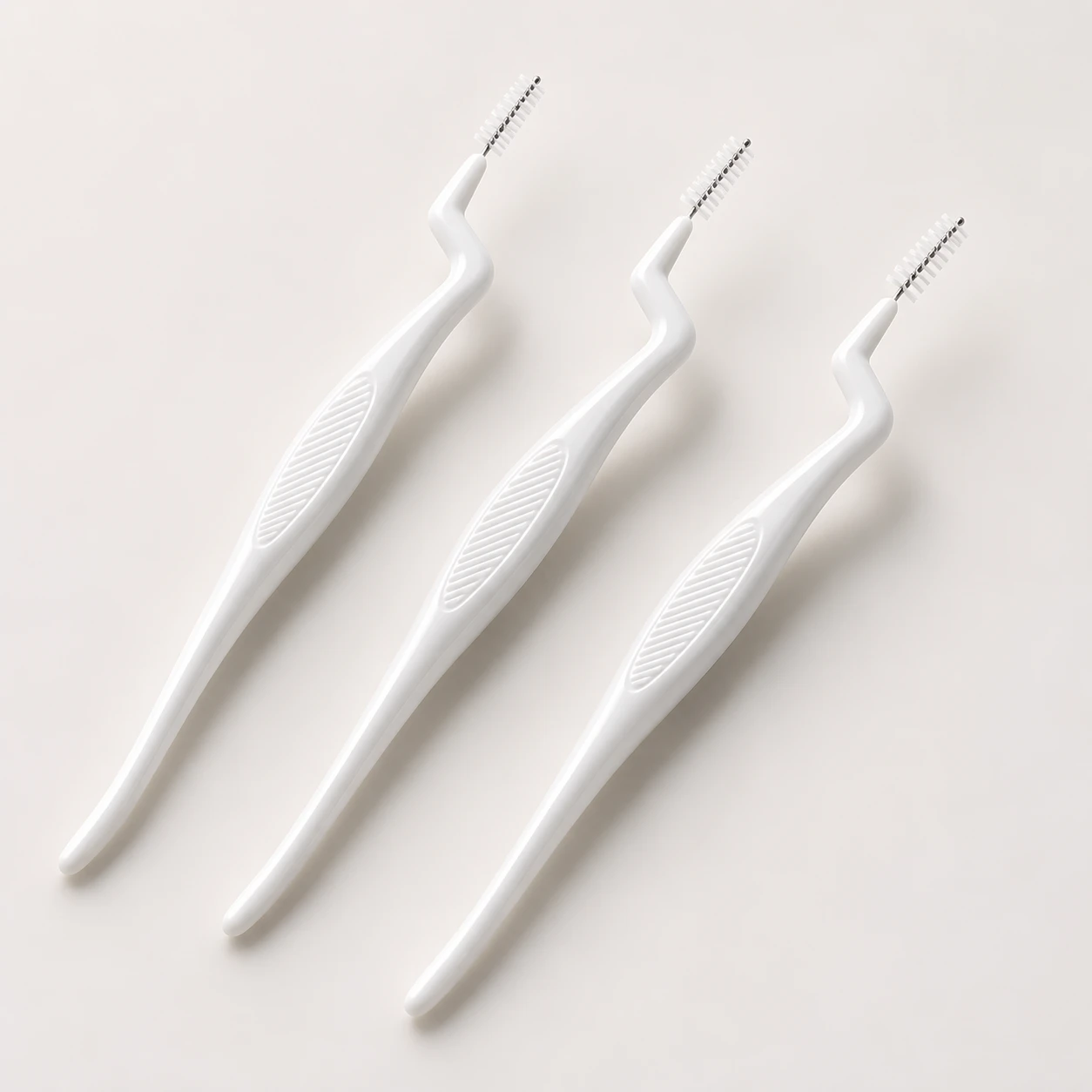
Interdental Brushes, and a Sizing Pack to find yours
Small twisted-wire brushes for the gaps floss skims past: wider spaces, and the teeth around braces, bridges, and implants. Find your sizes first, then buy only those.
How the sizes work
Sizes follow the ISO 16409 numbering, from 0, the thinnest, up to 5. A higher number means the brush is made for a wider space.
Gaps differ across one mouth, often narrower at the front and wider at the back, so two sizes is normal. The Sizing Pack has two of every size and a printed card on how snug should feel. Within a week you know your sizes.
Animation: six brushes grow from size 0 to size 5, and each one passes through a ring sized to match it.
Good for
- Gaps wider than floss handles well
- Around braces, bridges, crowns, and implants
- Spaces that opened up as gums pulled back
- Anyone told to use brushes but not which size
Not the right tool for
- Gaps so tight floss barely goes in: use Angled Floss Picks
- Pushing through a gap: go down a size instead
- The tongue or the chewing surfaces
How to use them
Start small
Try size 0 first in each gap. It should slide in without pushing.
Size up until snug
Go up one size at a time until the brush touches both sides with slight resistance.
Straight in and out
Move it in and out a few times without twisting. Rinse it and put the cap on.
Change it on time
Use a new brush every 5 to 10 days, or sooner if the wire bends.
Specs
- Sizes
- ISO 0 to 5
- Sizing Pack
- 12 brushes, 2 of each size, sizing card
- Single size
- 20 brushes, 2 caps
- Change
- Every 5 to 10 days
- Refills
- Single-size packs, 15% off
Brush size questions
Why would I need two sizes?
Your gaps aren't all one width. Front gaps tend to be narrower than back ones, and the space beside a bridge or implant can be wider still. Two sizes covers most mouths. Some need three.
How do I know a size is right?
It goes in without force, touches both sides, and you feel a little drag as it moves. If it slides through with no contact, go up a size. If you have to push, go down.
Should it bleed?
A brush shouldn't hurt. If it does, or a gap bleeds, drop a size and go gentler. Bleeding that keeps coming back is worth raising with your dentist.
Can I use one brush more than once?
Yes, for 5 to 10 days. Rinse it after each use, let it dry with the cap off, and cap it for travel.